

The coefficient of thermal expansion (CTE) is a crucial property when it comes to understanding the behavior of materials under temperature changes. In the context of flange spade terminals, this characteristic plays a significant role in ensuring their performance, reliability, and safety in various electrical applications. As a supplier of flange spade terminals, I am well - versed in the importance of CTE and its implications for our products.
Understanding the Coefficient of Thermal Expansion
The coefficient of thermal expansion is defined as the fractional change in length or volume of a material per unit change in temperature. Mathematically, for linear expansion, the coefficient of linear thermal expansion (α) is given by the formula:
[ \alpha=\frac{\Delta L}{L_0\Delta T} ]
where (\Delta L) is the change in length, (L_0) is the original length, and (\Delta T) is the change in temperature. The unit of α is typically (K^{-1}) or (^{\circ}C^{-1}).
For volume expansion, the coefficient of volume thermal expansion (β) is approximately 3α for isotropic materials.

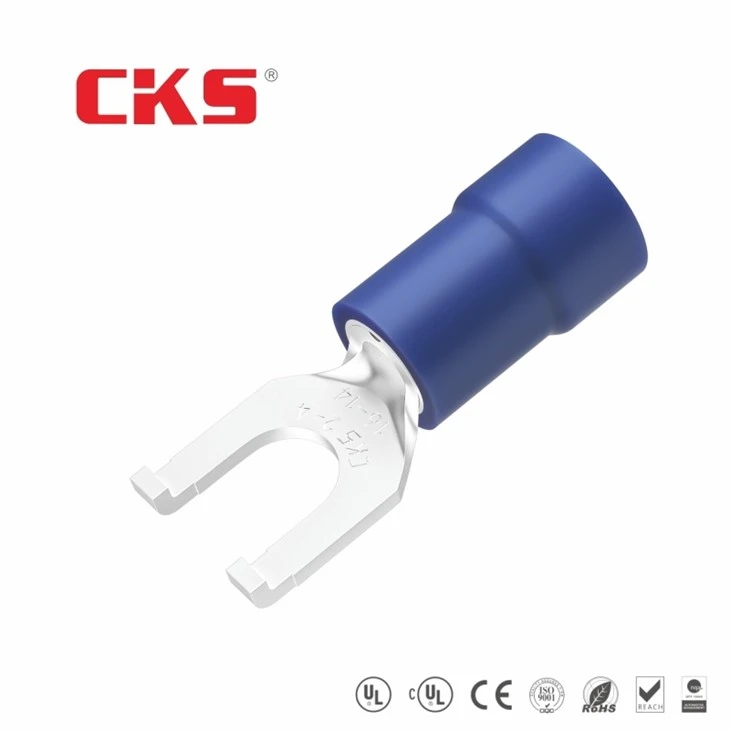
Why CTE Matters for Flange Spade Terminals
Flange spade terminals are used in a wide range of electrical systems, from automotive electronics to industrial control panels. These terminals are often exposed to varying temperatures during operation. If the CTE of the terminal material is not properly considered, it can lead to several problems:
Loose Connections
When a flange spade terminal is subjected to temperature changes, it expands or contracts. If the CTE of the terminal material is significantly different from that of the mating component (such as a busbar or a wire), the terminal may expand or contract at a different rate. This can result in a loose connection over time, increasing electrical resistance and potentially causing overheating, arcing, and even system failure.
Mechanical Stress
Differential thermal expansion can also induce mechanical stress on the terminal and its surrounding components. This stress can cause deformation, cracking, or fatigue failure of the terminal, reducing its lifespan and reliability.
CTE of Common Materials Used in Flange Spade Terminals
Flange spade terminals are typically made from materials such as copper, brass, and aluminum. Each of these materials has its own characteristic CTE:
Copper
Copper is a popular choice for flange spade terminals due to its excellent electrical conductivity. The coefficient of linear thermal expansion of copper is approximately (16.5\times10^{-6}\ K^{-1}). This relatively low CTE makes copper a stable material for electrical connections, as it expands and contracts in a predictable manner with temperature changes.
Brass
Brass is an alloy of copper and zinc. The CTE of brass depends on its composition, but it is generally in the range of (18 - 20\times10^{-6}\ K^{-1}). Brass offers good corrosion resistance and mechanical strength, and its CTE is close enough to that of copper to be used in conjunction with copper components in many applications.
Aluminum
Aluminum is a lightweight and cost - effective alternative to copper. The coefficient of linear thermal expansion of aluminum is about (23\times10^{-6}\ K^{-1}), which is higher than that of copper and brass. When using aluminum flange spade terminals, it is important to ensure that the mating components have a compatible CTE to prevent connection problems.
Our Product Range and CTE Considerations
As a supplier of flange spade terminals, we offer a wide range of products to meet the diverse needs of our customers. Our product portfolio includes Non Insulated Flange Spade Fork Terminals, Insulated PVC VINYL Flange Spade Terminal, and Doble Crimp Flange Spade Fork Terminal.
We carefully select the materials for our terminals based on their CTE and other properties such as electrical conductivity, mechanical strength, and corrosion resistance. For applications where temperature variations are significant, we recommend using terminals made from materials with a low and well - matched CTE to ensure a stable and reliable connection.
Testing and Quality Assurance
To ensure the quality and performance of our flange spade terminals, we conduct rigorous testing procedures. Our testing includes thermal cycling tests, where the terminals are subjected to repeated temperature changes to simulate real - world operating conditions. During these tests, we measure the change in dimensions and electrical properties of the terminals to verify that they meet our quality standards.
We also perform electrical conductivity tests and mechanical strength tests to ensure that the terminals can withstand the demands of their intended applications. By closely monitoring the CTE of our terminal materials and conducting comprehensive testing, we can provide our customers with high - quality products that offer long - term reliability.
Application - Specific Considerations
Different applications may have different requirements for the CTE of flange spade terminals. For example:
Automotive Applications
In automotive electronics, flange spade terminals are exposed to a wide range of temperatures, from the cold start in winter to the high - temperature operation under the hood. The CTE of the terminals must be carefully matched to the surrounding components to ensure reliable electrical connections and prevent mechanical failure.
Industrial Applications
Industrial control panels often operate in harsh environments with significant temperature variations. Flange spade terminals used in these applications need to have a stable CTE to maintain proper electrical contact and prevent overheating.
Contact Us for Your Flange Spade Terminal Needs
If you are in the market for high - quality flange spade terminals, we are here to help. Our team of experts can assist you in selecting the right terminal for your specific application, taking into account factors such as CTE, electrical conductivity, and mechanical strength.
Whether you need a small quantity for a prototype or a large - scale production order, we can provide you with the products you need at competitive prices. Contact us today to discuss your requirements and start a partnership that will ensure the success of your electrical projects.
References
- Incropera, F. P., DeWitt, D. P., Bergman, T. L., & Lavine, A. S. (2007). Fundamentals of Heat and Mass Transfer. Wiley.
- Callister, W. D., & Rethwisch, D. G. (2010). Materials Science and Engineering: An Introduction. Wiley.
- Groover, M. P. (2010). Fundamentals of Modern Manufacturing: Materials, Processes, and Systems. Wiley.