

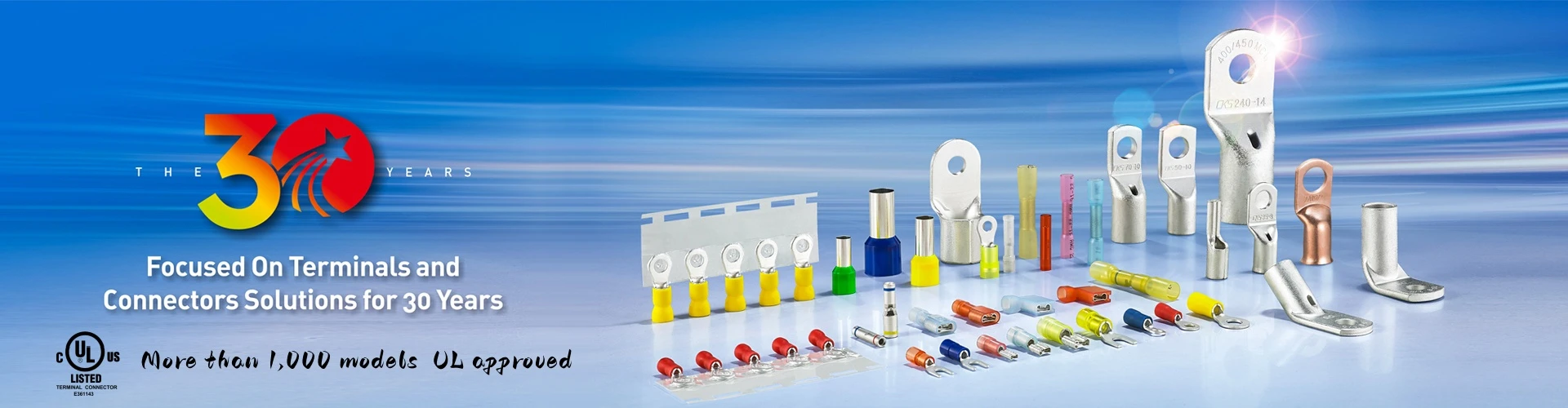
Selecting copper cable lugs is a crucial step to ensure the safety and reliability of electrical connections. The core point of choosing copper cable lugs is that the lugs must be fully compatible with the material, cross-sectional area and structure of the cables. (Cross-sectional area: The cross-sectional area of the connector must be larger than that of the cable. For example, for a 50 square millimeter copper wire, a lug with a cross-sectional area of more than 50 square millimeters should be selected.)
Why must the cross-sectional area of the copper cable connector be larger than cable? The cross-sectional area of the cable directly determines its rated current carrying capacity (the maximum current that can be continuously passed through). The main function of the copper connector is to connect the cable and conduct the current.
If the cross-sectional area of the copper connector is smaller than cable: the conducting area at the connector will be insufficient, and the resistance will significantly increase. When the current passes through, the connector will generate excessive heat due to "excessive resistance", and long-term overheating may cause the insulation layer to age, melt, and even lead to short circuits, fires and other safety accidents.
Current is further divided into long-duration large current and instantaneous large current.
Instantaneous high current refers to a situation where the current value surges to an extremely high level within an extremely short period of time (usually at the millisecond level). Although the current value is huge, due to the short duration, the generated heat has no time to be fully conducted and accumulated, and thus the impact on the overall temperature rise is relatively small.
Instantaneous high current refers to a situation where the current value surges to an extremely high level within an extremely short period of time (usually at the millisecond level). Although the current value is huge, due to the short duration, the generated heat has no time to be fully conducted and accumulated, and thus the impact on the overall temperature rise is relatively small.
We have experienced a serious accident where the copper cable lug of an electric forklift melted during the process of loading goods. This was the result of the combined effect of long-term high current and poor contact. When the customer chose the copper cable connector, they did not inform us of the usage scenario. To reduce costs, they requested us to provide copper tubes with thinner wall thickness for production. They believed that as long as it was used within the rated current range, there would be no problem.
When the forklift is unloaded, there is no continuous long-term high current. However, when carrying goods, the forklift motor is in an overloading state for a long time, and the working current exceeds the rated current capacity of the cable and connector. The continuous high current causes the connector temperature to gradually rise, eventually resulting in a fuse blowout. Of course, if the lugs itself does not meet the specifications, it will also increase the risk of fuse blowout.
Insufficient cross-sectional area: If the nominal cross-sectional area of the lug is smaller than that of the cable, the current density at the joint will increase, leading to overheating.
Terminal with mismatched copper tube thickness: The thickness of the copper tube is closely related to the cross-sectional area and rated current of the cable. For example, when selecting the crimping of the copper tube, the corresponding specification of the copper tube should be chosen based on the cross-sectional area of the cable. Different specifications of copper tubes have corresponding wall thicknesses to ensure a quick and resistive electrical connection after crimping. Therefore, when customers make selections later, we also need to consider the specific usage scenarios.
First of all, we will definitely recommend that customers choose cable connectors that are exactly matched in material, cross-sectional area and structure with the cables. CKS's copper cable lugs are produced with standard thickness requirements and comply with international standards.
Regarding the access hole issue: The size of the access hole has an impact on the cross-section. For long-term high current, the CKS copper tube series terminals can be selected. Such as SC square small access hole \ SCK square small access hole \ DSC without access hole, etc. The function of the access hole is to facilitate checking whether the wires are properly pressed, but it is not a necessary option. Many customers choose the SC semi-circular access hole and can still use it normally because the working current does not exceed the maximum load current of the terminal.
Regarding the crimping issue: This is the most common installation problem. Using mismatched crimping tools, insufficient crimping times or improper operation will reduce the contact area between the cable and the connector, resulting in poor contact. It is important to ensure that the crimping of the terminal and the wire is tight and not loose, otherwise the current and resistance will increase, which may damage the equipment. Long-term high current wires and terminals may melt.