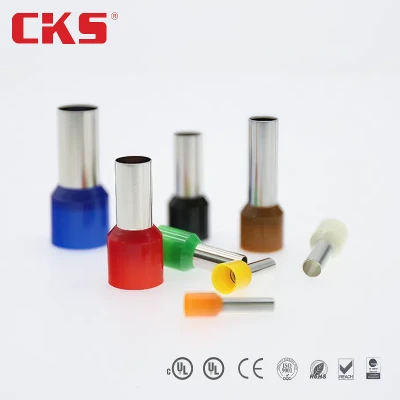
Electrical ferrule connectors, a type of low-voltage electrical connectors, are mainly used to connect cable lines and transmit electrical energy signals. Their basic structure consists of two parts: metal and insulating sleeves, and they are connected by crimping.
CKS Electrical ferrule connectors comply with the production standard of DIN46228, and are divided into non insulated electrical ferrule connectors and insulated electrical ferrule connectors.
Non insulated electrical ferrule connectors
CKS non insulated electrical ferrule connectors are made of high-conductivity T2 oxygen-free copper (the copper content of oxygen-free copper is not less than 99.99%, a metallic material with good electrical conductivity and corrosion resistance). Additionally, T2 oxygen-free copper has excellent ductility and plasticity, with moderate strength, enabling it to withstand certain external forces while being easy to process and form. The surface is tin-plated. The tin-plated layer can provide a certain anti-corrosion effect, especially in harsh environments, and can also extend the service life of terminals and ensure good electrical conductivity.
The tail of the non insulated electrical ferrule connectors is designed with an easy wire-passing port in a horn shape. This horn-shaped inlet can guide the wire smoothly into the ferrule, reduce wire backtracking, and ensure the integrity of the wire connection.
The wiring ranges of bare tubular ferrules are as follows:
22-18AWG (wire cross-sectional area: 0.5-1mm²): Commonly used for internal connection circuits of low-current and low-voltage electronic devices, small sensor lines, and fine control circuit wires.
16-10AWG (wire cross-sectional area: 1.5-6mm²): This specification has a wide range of applications, covering home electrical wiring, part of the internal circuits of automobiles, and low-power motors and control circuits in some industrial equipment.
8-3/0AWG (wire cross-sectional area: 10-95mm²): This large specification is suitable for power transmission in power distribution cabinets of large factories, transformer connection lines, and power cords of high-power appliances such as large air conditioners and water heaters, ensuring connection reliability.
Insulated electrical ferrule connectors
Insulated electrical ferrule connectors are covered with an insulating protective sleeve (the insulating protective sleeve is made of polypropylene PP or polyamide PA), which has the characteristics of insulation, wear resistance, and flame retardancy.
The insulating sleeves of pre-insulated tubular ferrules come in more than a dozen different colors to indicate wire specifications. This design allows for quick identification through the color of the insulating protective sleeve, enabling electricians to quickly match ferrules with wires during installation and maintenance without the need for tool measurement, reducing operational errors and improving installation efficiency.
The wiring range of insulated electrical ferrule connectors are 22-3/0AWG (wire cross-sectional area: 0.5-95mm²). The length of the insulating sleeve depends on the wire specification and mechanical strength requirements-the thicker the wire, the longer the sleeve.
Insulated electrical ferrule connectors are divided into single-wire and double-wire types. Double-wire ferrules can connect two wires with the same cross-sectional area at the same time. Compared with single-wire pre-insulated ferrules, double-wire connection greatly improves connection efficiency. In some circuits requiring the connection of multiple wires, it can effectively simplify the wiring structure and make the circuit wiring more compact and neat.