

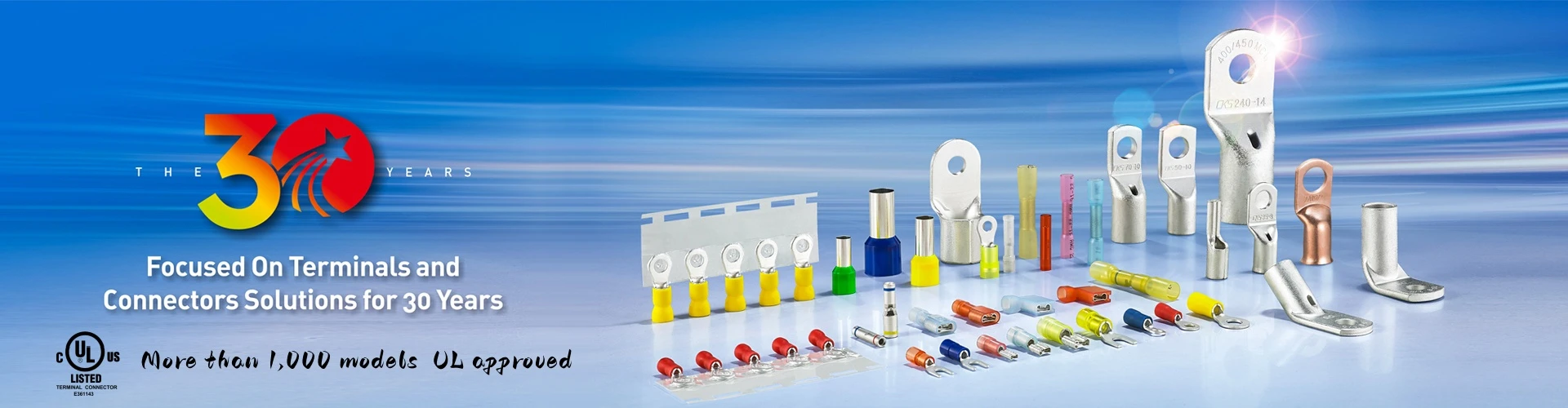
battery cable lugs are copper cable connectors used for battery connections, usually between batteries, between batteries and inverters, charge controllers or battery chargers.
In the connection between batteries, the battery cable lug is a key component to realize the multi-battery parallel/series system. Its function is to connect the positive and negative electrodes of the parallel/series batteries through the cable crimped with the battery cable lug to form a current path. (Such as SC with peephole, SC square peephole, DSC without peephole).


The battery cable lug is convenient for connection and replacement. In a battery parallel system, if a battery needs to be replaced or repaired, just loosen the screws to repair and replace it without affecting the wiring of the entire system. Different battery systems have different specifications and current carrying capacity. The commonly used connection terminals and specifications are shown in the following table.

| Cable Cross-Section |
Stud size |
|
|
Ø8 -16 |
16mm² |
M8 |
|
Ø8 - 25 |
25mm² |
M8 |
|
Ø10 - 35 |
35mm² |
M10 |
|
Ø10 - 50 |
50mm² |
M10 |
|
Ø10 - 70 |
70mm² |
M10 |
In the connection between the battery and the inverter, the battery outputs electrical energy through the positive and negative terminals. The input end of the inverter needs to be connected to the positive and negative terminals of the battery, and a combination kit of different battery cable lugs is required. The combination kit can include battery cable lugs of corresponding sizes and cable lengths. There is no need for on-site processing during installation, only corresponding specifications are required.

Conventional battery cable lugs are made of T2 copper and are tinned for corrosion resistance. After being applied to new energy, in order to cope with the new requirements for terminal materials in flow batteries (such as all-vanadium flow batteries) due to the strong corrosion of electrolytes, nickel-plated copper terminals (nickel layer thickness ≥ 5μm) are used, which have a lifespan three times longer than ordinary copper terminals.